 Noa The Game
Volatility and average: a field report
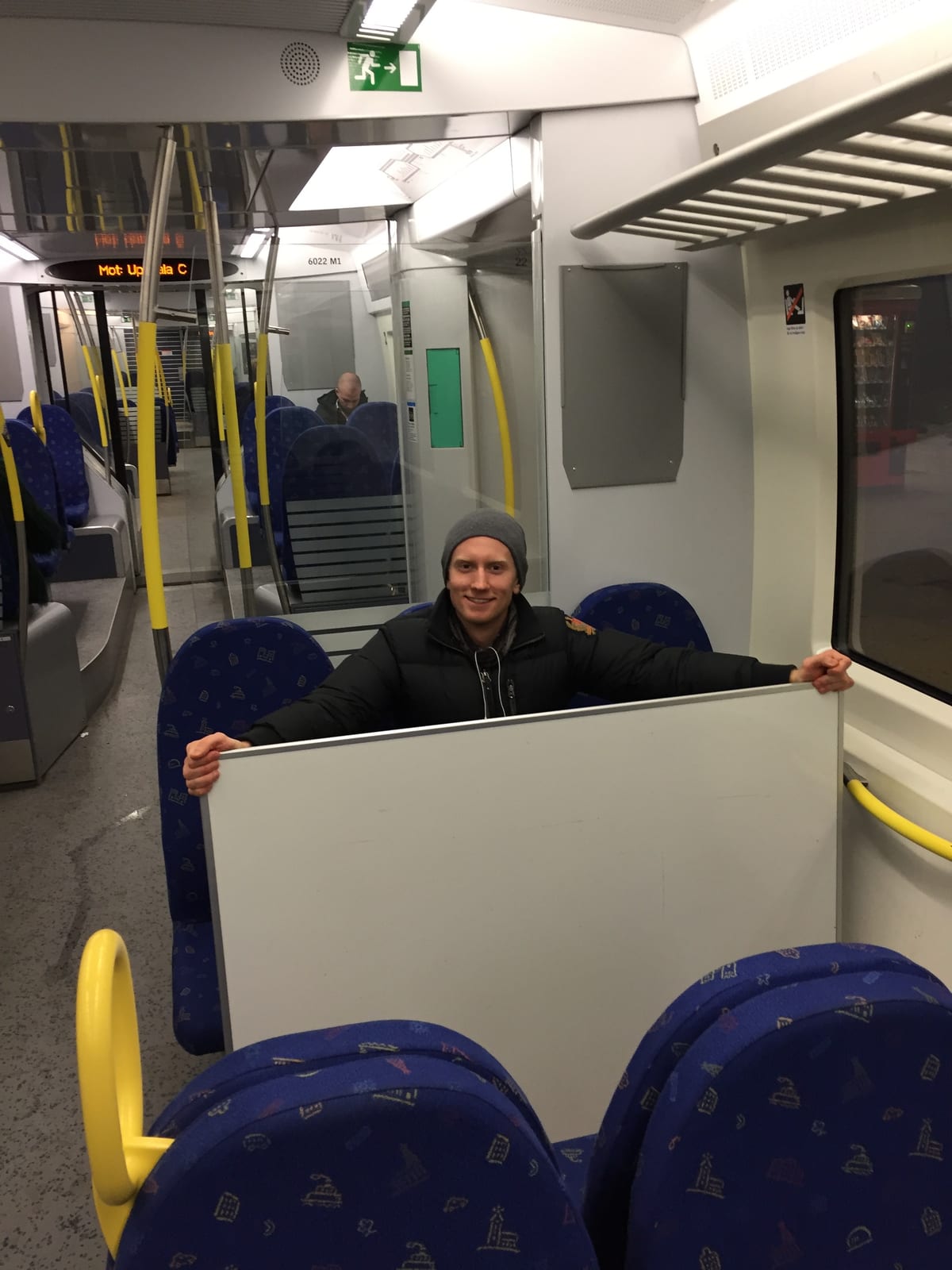
It’s late. I’m lying in bed recording this, I’m tired…
I just want to put on a series right now. I want to dull the tension in my head and my body after the intensity of the working day, the pull toward that lovely dopamine rush is strong.
This is a conflict that keeps coming back in me.
That’s why this text exists. I’ve tested living both ways, with the stimulants and without, and what I’m sharing here is my thoughts so far. I’m not finished with this experiment. It’s still running, literally tonight.
The start of the experiment
In the autumn of 2015 I was 23 and living in a southern suburb of Stockholm, Sweden with two of my best friends. My life was about going full speed. Go, go, go. It could never go quiet. I couldn’t be alone; the moment the flat emptied out I called someone.
I had started therapy because of my restlessness and anxiety. After the third session my therapist said: “Fredrik, you have an answer for everything. If you want to do this for real you have to stop having an answer for everything, otherwise you can’t come back.” I came close to dropping the whole thing. But curiosity won: what’s on the other side?
An ADHD assessment later, I stopped hating myself. I had something to work from. I didn’t want to take pills, so I did what the internet said helps: meditation and strength training. Let’s do it.
And then I designed the experiment, long before the words dopamine detox existed: away with every source of dopamine that wasn’t building me. Out with the alcohol, the porn, the caffeine and the sugar. The series went too, no films at home; if I wanted to watch something I went to the cinema. The scrolling disappeared when I deleted the apps. Essentially food was the only thing allowed to consume dopamine. The rest I had to generate myself, without consumption.
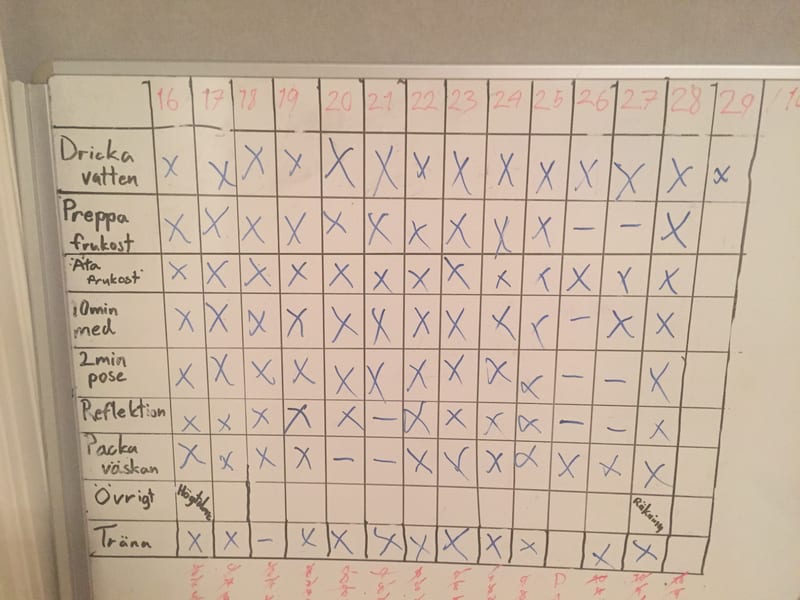
In my first place of my own, on Kungsholmen, I put up four whiteboards and started marking down what I actually did. I didn’t think I was scrolling. The tracking showed four or five times in the first hours alone. I was lying to myself. That was the first thing the experiment taught me.
The measurements
At first it got harder. When the empty pleasures were switched off I became very aware of my anxiety. The swings increased, that was measurement no. 1.
But my body started looking for something more. Motivation turned up in the strangest places: in the washing-up, in the bills. The body started by nature looking for progression. I sat down at the piano. I started drawing and painting, for the first time in fifteen years. I read. I meditated. When the empty pleasures were shut off the body went looking for creation, that was measurement no. 2.
And somewhere after the hard weeks the calm arrived. First as an explosion: I had booked a yoga class on a Saturday morning, after being challenged to look for one thing I couldn’t see myself doing. In the middle of the class a shining light lit up behind my closed eyes and exploded. Afterwards I cycled through town and stopped by an underground station, still high, completely present in every breath. A wonderful experience of existing.
Much later the calm came back in another form: as everyday life. The evenings on Kungsholmen, a cup of tea from the box my brother gave me for Christmas and a crackling virtual fire on the television, just sitting. I remember a meditation on the sofa when the thought came: I could sit here until I fade away and die, and that would be completely fine. I was rich in silence and calm. Content with nothing at all. Everything was perfect as it was.
The finding
And this is where the experiment surprised me.
Without the stimulants life swung more, not less. The hard days were still there, they even became clearer. But the average of happiness rose to all-time highs, consistently, month after month. That’s the whole model, and it’s simple: the stimulants dampen the swings, but they lower the average over time. Take them away and life becomes more volatile, harder and more beautiful at the same time, but the underlying contentment rises.
The strongest discovery was still a different one: being alive. It wasn’t only about being happy. It was about daring to be present even on the days I didn’t feel happy. When it was hard I stayed in it. I breathed through the pain instead of pushing it away. And I was just as present in what was happy and good. I was here and now. I existed here and now. It’s an extraordinary way to live.
I want to be honest about one thing: the model of volatility and average is my own, pieced together from my own life. It isn’t science, it’s data from an experiment with one participant. To begin with. More participants came later.
Coming home
The years that followed, six or seven of them, only stepped it up. I got more calm. I worked on peeling away programming, on understanding my own thinking and how it was coloured by my history. I went deeper than I have room for here.
And at some point it just landed: now I’ve found my way home. Now it’s time to start living.
Then I did something that might sound backwards: I invited it back in. Beer with friends, board games, series. The fruits of life. I longed for them and found joy in them, together with people I liked. After such deeply soulful experiences it was part of coming home. The bar was raised, I was well, and pushing my health further gave less and less back. The gym, the fitness, the sleep became good, not perfect but enough, and that freed up room for other things.
At the same time work had been transformed. Life had substance, it was as if someone had plugged in the cord in me, and I was filled with energy. A friend asked me: “Fredrik, how do you find time for the spiritual now that you’re running a business and training?” I realized how the spiritual isn’t an activity you have to find time for. It’s the cord you plug yourself in with, so that you get energy for everything else. It’s what makes everything else flow.
The counter-experiment
Fast forward to the last two years, partly the last year in Thailand.
The stimulants have crept back. More phone, more scrolling in the in-between moments. Far more shows. More and more sweets. And that peaceful state of being alone, the one I was once rich in, is gone. The moments I used to fill with quality I now fill with empty pleasure.
The difference isn’t the substances. In the beginning I invited them in with joy, together with people I liked. The difference is that they have crept from conscious intentions into routine everyday leakage.
Bedtime, the biggest puck in my whole life. It used to be so easy for me to know: if I go to bed at nine I wake at five and get the morning hours, the ones I love, the ones that give rhythm and an anchor to the whole day. If I go to bed at midnight I wake at eight, feel slightly worse and feel like the day was mostly spent. This is how life seems to go, in peaks and troughs.
The difference today compared to before is that back then the missteps had enormous effects on everyday life, today it’s more like a mosquito bite.
So this is my next experiment, to choose the “right” path even when the cost of the misstep is very low.
Because the upside over the long run has turned out to be colossal.
The others
If it were only me this would stay a diary entry. But it isn’t only me.
I think about Kristina. During covid she lost her father and her best friend within three months, the two people who stood closest to her, the ones she called when she felt bad or lost. We founders were told a small part of it: she needed a few days, and then she was back. It was only six months later that she came to me and told me how deep it went.
The people close to us are a gravitational force that holds us to who we are. When it’s torn apart you lose your grip on the earth. You lose yourself completely, and you don’t know how to recreate that gravity. She said the tool was exactly that gravity for her, the thing that kept her on track.
Her habit was to roll out her yoga mat. That was all. Change clothes, roll out the mat, stand on it and take a few breaths, and only there ask herself whether she would do her session, or whether she was too drained to even start stretching out her body. That was the point, she said: that the bar was so extremely low. She allowed herself not to have to do the session, but she needed to roll out the mat and stand there, that was the requirement. And that small routine became the one thing that came back every day and was always the same, she had a time and she had a place, when everything else was tearing loose and in chaos.
And I think about Robin. He was a young guy, single and passionate, with options in the company and a lot of responsibility. He could watch the revenue go up every day and see exactly what he did to make it go up. He saw how his hours translated into money, how the job was buying his flat. It’s an extremely relatable structure, and an attachment to work that wasn’t sustainable.
For him the tool became a way to break off. When we presented it and said “this is what we’re going to do” it was as if he was given permission to take the break. It wasn’t just allowed, it was actively encouraged. His relaxing breathing exercises became the way he ended the day: when he did them, work was over. Later he told me about his Friday routine. He went to the shop after work and bought scallops and fresh seafood, and held a proper weekend feast with himself. When he told me that I understood: now he has found a private life outside work, one that is rich for him.
And it’s here, only here, that I allow myself to draw a conclusion, because I have seen it proven beyond myself.
Why does it work the same way for everyone? Because I don’t tell anyone what to do. What I’ve built is a process you apply yourself into. You make the decision about what you’re going to do. You decide how to carry it out. You commit for a week, report every day and reflect at the end. All the responsibility sits in your hands, there is no authority to hand it over to. A hundred percent your own responsibility.
And that, I think, is something people are quite unused to: getting to practise responsibility that way as an adult, and being seen in it. Nobody comes back to me and says “you told me what to do and now I feel better”. They look at themselves in the mirror and realise: I was the one who said what I would do. I built the strategy, I reported, and I made sure it got done.
There’s a sentence that has echoed in my head for years: give the power back to the human being. Hold up a mirror and show that you’re the one setting the terms. You can be as lazy or as ambitious as you like. I don’t care, and nobody else cares either. You get no gold star in the record. But that pat on the back you can give yourself, that transforms your whole reality.
Your experiment
I have one thing to ask of you, if you want to test it.
Look at your life: what is it you know leaks energy? Where are you wasting your time? Pick one thing. The time horizon is a week, you don’t commit to more than that.
Then come the premises, and they can’t be bent. You don’t have to succeed with your habit every day. But you have to report every day: yes or no, regardless. Monday to Friday is uncompromising, then you can take a break at the weekend. And you report where others can see it. Because the moment you start looking the other way, the moment you can’t be bothered to report when you know you haven’t done it, all the power disappears. If you report your no you keep the habit in your awareness. And as long as you keep it in your awareness it will work sooner or later. Do this halfway and you won’t get the result. Do it fully, and then I promise you, it works.
At the end of the period you reflect, together with others, on how it went. And run two months with the same habit if you can. Because then you get to see it with your own eyes, in your own life: “I can decide my behaviour and affect my outcome. I can automate a habit.” Once it’s automated the habit happens without costing energy. Over time the habits stack and start creating transformational changes in life.
My promise isn’t that you’ll become the healthiest person on earth. The promise is that you come out of those two months knowing, for the rest of your life, that if the shit hits the fan, if you ever stand in front of a change that has to be made, you have the power to deal with it. Self-confidence and self-worth. Security in knowing “I have control over my own life.” It’s the strongest insurance you can walk through your day with.
You’re the one in the driver’s seat. It’s your own life-car.
Tonight
Now I’ve said what I set out to say, and the pull toward the series is still there. The dulling intoxication of dopamine is one button press away… Surely one evening can’t make a difference, or can it?
I’m in the middle of the conflict now.
But tomorrow I report: “Yes” or “No”.
A note on the names: Kristina is not her real name. It’s fictional, to protect her privacy.